Why we need to ditch certainty and embrace uncertainty

Reading Time: 9 minutes

Certainty is highly prized by our brains. So much of what we do and say is aimed at creating certainty for ourselves, or projecting an aura of certainty for others to see. We often avoid uncertainty, because it can activate the threat-avoidance part of our brains.

The problem is usually not the uncertainty itself, but our lack of confidence in navigating it, or our lack of tools to manage it. It’s important to understand that the only way we can change and grow as individuals, teams and societies is through embracing and working with uncertainty.

I’m convinced that we need to embrace uncertainty wholeheartedly in our lives and organisations. Once we understand why we react the way we do to uncertainty, we can learn how to use it to drive growth, improvement and development, and even have fun doing so!

My confession

I’m a recovering certainty addict. For much of my life, I prized knowing and control (i.e. certainty) over uncertainty and unfolding (and I still struggle with this at times). While I thought the way I was approaching life was “good”, because I felt like I was making things happen, and doing the “right” things, I came to realise that my approach had significant drawbacks:

I was stressed

It’s not easy trying to convince yourself that you are in charge when there are so many things over which you have utterly zero control – the weather, the traffic, other people’s actions and words, the lottery numbers, world events…

I felt like a failure

With so many things going on around me that I couldn’t control, if I didn’t achieve my plans or targets perfectly, I placed 100% of the blame on myself. The problem was, I’d made my plans and set my targets assuming that everything would go exactly the way I wanted it to.

And when it didn’t, I assumed that I had done something wrong. I guess technically I had – at the planning stage, I could have assumed there would be roadblocks and diversions, and made more adaptable plans and targets. But, for some reason, I tried to shoulder all of the responsibility, even for things that I had no chance of influencing, let alone controlling.

I didn't take risks

Desiring certainty and control above everything else led me to always “play it safe”. I followed what I assumed to be the rulebook for life. I did my best to conform to other people’s expectations. And boy, did that leave me feeling hollow!

Even when it looked outwardly like I was taking a risk (say, travelling to non-English-speaking countries alone for a couple of months) I played it safe by going to countries where I could speak the language fluently, or at least had a working knowledge of the language. I knew I couldn’t “fail” by getting myself into a situation where I didn’t understand what was going on or how to get myself out of it.

I also stayed in jobs long past the time that they were serving me because I was afraid of the uncertainty of whether I would be capable of whatever new job I took.

I was exhausted and burned out

This goes hand-in-hand with being stressed – I blew all my energy and internal resources on trying to control the uncontrollable, which left me no energy to nurture myself.

I didn't feel much joy or satisfaction in my life

I was so busy checking and assessing myself and my life that I wasn’t savouring the experience of being alive in this amazing, wonderful world. My mind was full of questions: Am I doing the right things? Does so-and-so approve of my choices? If X happens, what will I do? What if Y happens? How can I make sure that Z never happens? How can I avoid risks entirely? How can I make absolutely sure that I succeed in absolutely everything I do?

The old treadmill problem

It was like I’d jumped onto a treadmill that was always increasing in speed. It ended up going so fast that it didn’t matter whether I chose to stay on, or get off – either way, I was going to hurt myself. Striving for certainty wasn’t working out for me. I had to jump off the treadmill.

Thankfully, I learned how my brain’s wiring had backed me into a corner, and how to re-frame my beliefs and experiences to move me into a different – more positive – relationship with uncertainty.

photo of person using treadmill

What's with the wiring?

The human brain is a wonderful thing. It starts working the moment you are born and never stops until you stand up to speak in public.

Our brains really are marvellous – just think of all the incredible discoveries and creativity and achievements of the human race. The brain is the catalyst for them all.

But behind all these marvellous accomplishments lies a rather odd design “feature” – the part of our body that allows us to achieve inspired results is also wired to keep us out of the zone where we can get those results.

I’m talking about our brain’s desire for certainty. Our brains love things that are safe and familiar, tried and true – we get a hit of dopamine (reward) as our expectations are met. Meanwhile, anything that looks unusual, new, unfamiliar or uncertain can trigger the amygdala (part of the limbic system in the brain responsible for survival instincts, among other things).
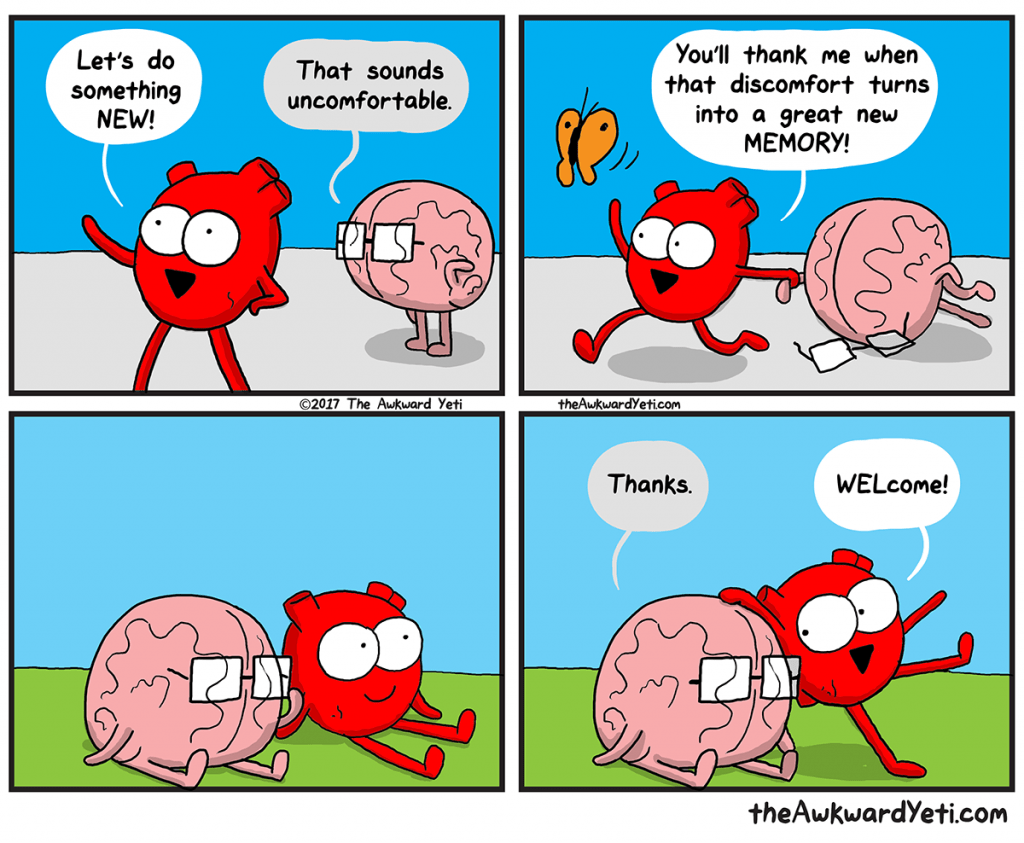
Cartoon, Awkward Yeti: Heart wants to do new things, but Brain is worried it will be uncomfortable, but then thanks Heart.
Heart sometimes knows best

Uncertainty and our nervous system

When we have a sense of certainty, our sympathetic nervous system (SNS – the flight or flight system) relaxes, and the parasympathetic nervous system (PNS – the rest and digest system) does its thing. Which is a good thing if all you want to do is lie around enjoying your food. But living with the PNS permanently engaged is fatal to anyone who desires to grow, learn, and make a difference in this world. You can read more about this in my article about the autonomic nervous system.

I'm convinced that we need more uncertainty

Ah yes, the paradox of writing a post in which I share my certainty about the vital importance of uncertainty! But hear me out – embracing uncertainty has so many benefits:

  • It creates space for learning – if you are 100% certain about something, you’re not open to new information about it
  • We can let go of the idea that there is only one way of “knowing”, which helps us embrace diverse thoughts, designs and ways to do things
  • Creativity bubbles up when we break free of the rules
  • We can create a culture that values experimentation and learning, instead of the usual success/failure paradigm, where if you try something and it doesn’t work, you are a failure, rather than Edison’s supposed “I haven’t failed. I’ve just found 10,000 ways that don’t work”.
  • We can adapt and respond when things don’t go the way we planned
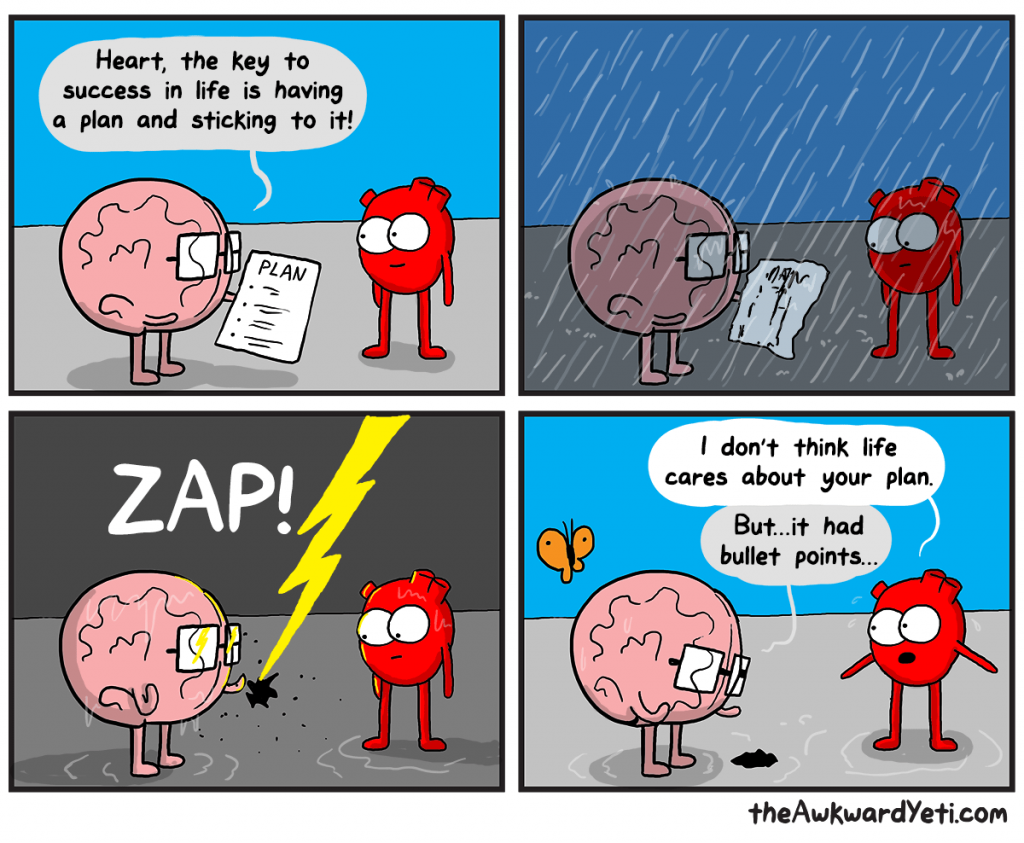
Cartoon, Awkward Yeti, about how Brain loves a plan, but nature destroys it with rain and lightning.
Not even bullet points can save us from unexpected evets

Allow me to clarify...

I’m not advocating for embracing uncertainty merely for the purpose of transforming it into certainty. In fact, that’s the opposite of my philosophy! 

I believe we need to learn how to tolerate enough uncertainty that we can work in the realm of possibility and create the kind of future we desire. And when we aren’t spending every minute trying to control everything, we have time to pause, reflect, savour and enjoy this amazing opportunity of being alive.

What uncertainty isn't

Too often, uncertainty gets mistaken for other things. Here are a few things that uncertainty is not:

  • a lack of self-confidence. You need a heck of a lot of self-belief to embrace living with uncertainty!
  • being unclear about your purpose, mission, and goals. If you don’t know where you’re heading, and why, you’ll never get there.
  • a lack of leadership capacity or ability. In fact, it takes a deeply confident leader to deliberately lead people into and through uncertainty to go to new levels of insight, action and performance.
  • an excuse to leap into action without doing your research and thinking first. The more aware you are of your context, whether business or personal, the more prepared you will be to navigate uncertainty and achieve success.

Uncertainty is the foundation for growth

Only in giving up the security of the known can we create new opportunities, grow capability, build confidence and expand our influence.
Margie Warrell in Forbes

Life moves at the speed of light these days – we can’t guarantee that what was true yesterday is true today. It’s no wonder our brains crave certainty.

However, if we don’t embrace uncertainty, we can’t learn, grow, explore, create and discover new things. So, how exactly do we embrace uncertainty?

Blackboard with a question mark in white chalk
It's OK to question everything. Image source: Pexels

We can embrace uncertainty

Such an easy phrase to write, and so challenging to practise! The first principle of embracing uncertainty is to be kind to ourselves on the journey. Some days we can handle anything, other days not so much. So be prepared to surf the waves of what you can handle – this is a marathon, not a sprint!

How to embrace uncertainty

Remind yourself that change is part of being human

Look at how much you’ve changed since childhood. Change is often a very good thing!

Write about when you’ve faced uncertainty before

Think about a time of uncertainty you faced recently (e.g. changing schools/jobs, a new relationship, travelling somewhere different). Remember it in vivid detail, then write down what you learned from the experience. This builds emotional resilience as you call to mind your ability to cope with uncertainty.

Be prepared for emotions to surface

Especially frustration, fear, anger, anxiety, doubt. Try naming the emotion and thinking about what your subconscious might be trying to communicate. 

Develop and use mantras

Mantras are a great way of reminding ourselves of what’s important or helpful. Repeating them to ourselves builds the neural pathways in our brains, strengthening our belief in the message of the mantra.

Some examples:

  • “This too shall pass”,
  • “Something good will come out of this”,
  • “I’ve survived 100% of my tough days so far”.

Build a support crew

This might be friends, family, or an online community – anyone who gives you a positive boost when you need it.

Find one or two people who will support you when you’re feeling vulnerable, and be open about what’s going on.

Feeling seen and heard by someone who accepts you is immensely soothing to your sympathetic nervous system – it dials down the feeling of threat because you’re surrounded by your tribe.

A trusted coach can be a foundational part of your support crew. I offer one-off and ongoing coaching for people who are ready to do things differently and get great results. If you’re interested in exploring how coaching can work for you, book your free 30min chemistry check call.

Remind yourself that control is an illusion

I don’t want to trigger or escalate any anxiety you might be feeling, but the reality is that we control only a tiny part of what happens to us, and only have partial control over our responses (check out my post on the autonomic nervous system for more information). 

Embracing the knowledge that we aren’t 100% responsible for everything can be quite freeing. It doesn’t mean we stop trying, it simply means that we don’t beat ourselves up if we don’t handle everything perfectly.

Work with what you truly can control

There are small and large things that you have control over – what you eat for breakfast, how and when you exercise, who you spend time with etc. These all contribute to your level of wellbeing. 

If something isn’t serving you, you can change it. If something is working well for you, you can maintain it, or tweak it to make it even better for you.

Play to your strengths

One strategy that can turbo-charge virtually anything you put your hand to is to play to your strengths. Once you know not just what you’re great at, but what lights you up (I call these your Genius strengths), you can find new and fun ways to incorporate them into your everyday life and work. Check out my tool, The Strengths Deck, which is a hands-on way to uncover and unleash your strengths.

How do we embrace uncertainty in organisations?

This is the million-dollar question (literally, for larger organisations!) I won’t be able to do this question justice in one single article, so I’ll summarise a few thoughts here. Much of my writing touches on this very issue, so I’ll link to other articles where I set out information in more detail.

Firstly – we need to develop a culture that embraces learning, risk-taking (appropriately, of course), and experimentation. Psychological safety is a huge component of this sort of culture.

Then, we need to create systems, processes and tools that support learning, risk-taking and experimentation. This approach is the essence of continuous improvement.

And, we need to accept that when we try something new, it’s very unlikely that we’ll execute brilliantly the first time we give it a go. So we need to embrace the idea that before we get good at something, we’ll start off being bad at it.
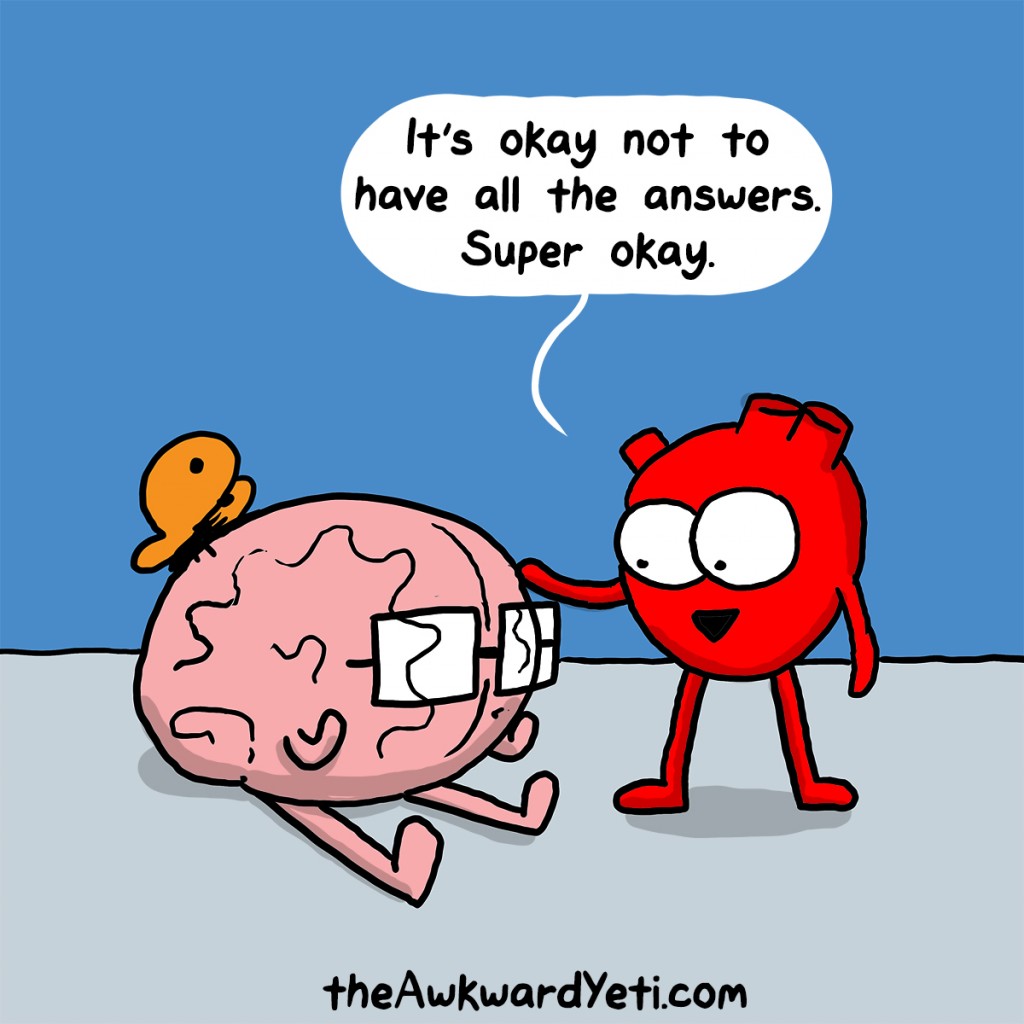
Cartoon, Awkward Yeti: Heart is saying to Brain 'It's okay not to have all the answers. Super okay'
Thank goodness!

Let's talk

If you’re looking for support to navigate uncertainty and turn it into an opportunity, let’s talk. I offer one-off and ongoing coaching programme for people who want to play to their strengths and create the kind of life and work they’ve been dreaming of.  Just hit the button below to book your free 30min chemistry check call.

If you’d like to learn more about how I coach, check out my coaching page. The two main types of coaching I offer are leadership coaching and strengths-based coaching. I also offer leadership development programmes for senior leaders and new leaders, as both in-house and public courses.

References

My thanks to the following writers for helping shape my thoughts about uncertainty:
Comments

Why we need to ditch certainty and embrace uncertainty

Reading Time: 9 minutes

Certainty is highly prized by our brains. So much of what we do and say is aimed at creating certainty for ourselves, or projecting an aura of certainty for others to see. We often avoid uncertainty, because it can activate the threat-avoidance part of our brains.

The problem is usually not the uncertainty itself, but our lack of confidence in navigating it, or our lack of tools to manage it. It’s important to understand that the only way we can change and grow as individuals, teams and societies is through embracing and working with uncertainty.

I’m convinced that we need to embrace uncertainty wholeheartedly in our lives and organisations. Once we understand why we react the way we do to uncertainty, we can learn how to use it to drive growth, improvement and development, and even have fun doing so!

My confession

I’m a recovering certainty addict. For much of my life, I prized knowing and control (i.e. certainty) over uncertainty and unfolding (and I still struggle with this at times). While I thought the way I was approaching life was “good”, because I felt like I was making things happen, and doing the “right” things, I came to realise that my approach had significant drawbacks:

I was stressed

It’s not easy trying to convince yourself that you are in charge when there are so many things over which you have utterly zero control – the weather, the traffic, other people’s actions and words, the lottery numbers, world events…

I felt like a failure

With so many things going on around me that I couldn’t control, if I didn’t achieve my plans or targets perfectly, I placed 100% of the blame on myself. The problem was, I’d made my plans and set my targets assuming that everything would go exactly the way I wanted it to.

And when it didn’t, I assumed that I had done something wrong. I guess technically I had – at the planning stage, I could have assumed there would be roadblocks and diversions, and made more adaptable plans and targets. But, for some reason, I tried to shoulder all of the responsibility, even for things that I had no chance of influencing, let alone controlling.

I didn't take risks

Desiring certainty and control above everything else led me to always “play it safe”. I followed what I assumed to be the rulebook for life. I did my best to conform to other people’s expectations. And boy, did that leave me feeling hollow!

Even when it looked outwardly like I was taking a risk (say, travelling to non-English-speaking countries alone for a couple of months) I played it safe by going to countries where I could speak the language fluently, or at least had a working knowledge of the language. I knew I couldn’t “fail” by getting myself into a situation where I didn’t understand what was going on or how to get myself out of it.

I also stayed in jobs long past the time that they were serving me because I was afraid of the uncertainty of whether I would be capable of whatever new job I took.

I was exhausted and burned out

This goes hand-in-hand with being stressed – I blew all my energy and internal resources on trying to control the uncontrollable, which left me no energy to nurture myself.

I didn't feel much joy or satisfaction in my life

I was so busy checking and assessing myself and my life that I wasn’t savouring the experience of being alive in this amazing, wonderful world. My mind was full of questions: Am I doing the right things? Does so-and-so approve of my choices? If X happens, what will I do? What if Y happens? How can I make sure that Z never happens? How can I avoid risks entirely? How can I make absolutely sure that I succeed in absolutely everything I do?

The old treadmill problem

It was like I’d jumped onto a treadmill that was always increasing in speed. It ended up going so fast that it didn’t matter whether I chose to stay on, or get off – either way, I was going to hurt myself. Striving for certainty wasn’t working out for me. I had to jump off the treadmill.

Thankfully, I learned how my brain’s wiring had backed me into a corner, and how to re-frame my beliefs and experiences to move me into a different – more positive – relationship with uncertainty.

photo of person using treadmill

What's with the wiring?

The human brain is a wonderful thing. It starts working the moment you are born and never stops until you stand up to speak in public.

Our brains really are marvellous – just think of all the incredible discoveries and creativity and achievements of the human race. The brain is the catalyst for them all.

But behind all these marvellous accomplishments lies a rather odd design “feature” – the part of our body that allows us to achieve inspired results is also wired to keep us out of the zone where we can get those results.

I’m talking about our brain’s desire for certainty. Our brains love things that are safe and familiar, tried and true – we get a hit of dopamine (reward) as our expectations are met. Meanwhile, anything that looks unusual, new, unfamiliar or uncertain can trigger the amygdala (part of the limbic system in the brain responsible for survival instincts, among other things).

Cartoon, Awkward Yeti: Heart wants to do new things, but Brain is worried it will be uncomfortable, but then thanks Heart.
Heart sometimes knows best

Uncertainty and our nervous system

When we have a sense of certainty, our sympathetic nervous system (SNS – the flight or flight system) relaxes, and the parasympathetic nervous system (PNS – the rest and digest system) does its thing. Which is a good thing if all you want to do is lie around enjoying your food. But living with the PNS permanently engaged is fatal to anyone who desires to grow, learn, and make a difference in this world. You can read more about this in my article about the autonomic nervous system.

I'm convinced that we need more uncertainty

Ah yes, the paradox of writing a post in which I share my certainty about the vital importance of uncertainty! But hear me out – embracing uncertainty has so many benefits:

  • It creates space for learning – if you are 100% certain about something, you’re not open to new information about it
  • We can let go of the idea that there is only one way of “knowing”, which helps us embrace diverse thoughts, designs and ways to do things
  • Creativity bubbles up when we break free of the rules
  • We can create a culture that values experimentation and learning, instead of the usual success/failure paradigm, where if you try something and it doesn’t work, you are a failure, rather than Edison’s supposed “I haven’t failed. I’ve just found 10,000 ways that don’t work”.
  • We can adapt and respond when things don’t go the way we planned
Cartoon, Awkward Yeti, about how Brain loves a plan, but nature destroys it with rain and lightning.
Not even bullet points can save us from unexpected evets

Allow me to clarify...

I’m not advocating for embracing uncertainty merely for the purpose of transforming it into certainty. In fact, that’s the opposite of my philosophy! 

I believe we need to learn how to tolerate enough uncertainty that we can work in the realm of possibility and create the kind of future we desire. And when we aren’t spending every minute trying to control everything, we have time to pause, reflect, savour and enjoy this amazing opportunity of being alive.

What uncertainty isn't

Too often, uncertainty gets mistaken for other things. Here are a few things that uncertainty is not:

  • a lack of self-confidence. You need a heck of a lot of self-belief to embrace living with uncertainty!
  • being unclear about your purpose, mission, and goals. If you don’t know where you’re heading, and why, you’ll never get there.
  • a lack of leadership capacity or ability. In fact, it takes a deeply confident leader to deliberately lead people into and through uncertainty to go to new levels of insight, action and performance.
  • an excuse to leap into action without doing your research and thinking first. The more aware you are of your context, whether business or personal, the more prepared you will be to navigate uncertainty and achieve success.

Uncertainty is the foundation for growth

Only in giving up the security of the known can we create new opportunities, grow capability, build confidence and expand our influence.
Margie Warrell in Forbes

Life moves at the speed of light these days – we can’t guarantee that what was true yesterday is true today. It’s no wonder our brains crave certainty.

However, if we don’t embrace uncertainty, we can’t learn, grow, explore, create and discover new things. So, how exactly do we embrace uncertainty?

Blackboard with a question mark in white chalk
It's OK to question everything. Image source: Pexels

We can embrace uncertainty

Such an easy phrase to write, and so challenging to practise! The first principle of embracing uncertainty is to be kind to ourselves on the journey. Some days we can handle anything, other days not so much. So be prepared to surf the waves of what you can handle – this is a marathon, not a sprint!

How to embrace uncertainty

Remind yourself that change is part of being human

Look at how much you’ve changed since childhood. Change is often a very good thing!

Write about when you’ve faced uncertainty before

Think about a time of uncertainty you faced recently (e.g. changing schools/jobs, a new relationship, travelling somewhere different). Remember it in vivid detail, then write down what you learned from the experience. This builds emotional resilience as you call to mind your ability to cope with uncertainty.

Be prepared for emotions to surface

Especially frustration, fear, anger, anxiety, doubt. Try naming the emotion and thinking about what your subconscious might be trying to communicate. 

Develop and use mantras

Mantras are a great way of reminding ourselves of what’s important or helpful. Repeating them to ourselves builds the neural pathways in our brains, strengthening our belief in the message of the mantra.

Some examples:

  • “This too shall pass”,
  • “Something good will come out of this”,
  • “I’ve survived 100% of my tough days so far”.

Build a support crew

This might be friends, family, or an online community – anyone who gives you a positive boost when you need it.

Find one or two people who will support you when you’re feeling vulnerable, and be open about what’s going on.

Feeling seen and heard by someone who accepts you is immensely soothing to your sympathetic nervous system – it dials down the feeling of threat because you’re surrounded by your tribe.

A trusted coach can be a foundational part of your support crew. I offer one-off and ongoing coaching for people who are ready to do things differently and get great results. If you’re interested in exploring how coaching can work for you, book your free 30min chemistry check call.

Remind yourself that control is an illusion

I don’t want to trigger or escalate any anxiety you might be feeling, but the reality is that we control only a tiny part of what happens to us, and only have partial control over our responses (check out my post on the autonomic nervous system for more information). 

Embracing the knowledge that we aren’t 100% responsible for everything can be quite freeing. It doesn’t mean we stop trying, it simply means that we don’t beat ourselves up if we don’t handle everything perfectly.

Work with what you truly can control

There are small and large things that you have control over – what you eat for breakfast, how and when you exercise, who you spend time with etc. These all contribute to your level of wellbeing. 

If something isn’t serving you, you can change it. If something is working well for you, you can maintain it, or tweak it to make it even better for you.

Play to your strengths

One strategy that can turbo-charge virtually anything you put your hand to is to play to your strengths. Once you know not just what you’re great at, but what lights you up (I call these your Genius strengths), you can find new and fun ways to incorporate them into your everyday life and work. Check out my tool, The Strengths Deck, which is a hands-on way to uncover and unleash your strengths.

How do we embrace uncertainty in organisations?

This is the million-dollar question (literally, for larger organisations!) I won’t be able to do this question justice in one single article, so I’ll summarise a few thoughts here. Much of my writing touches on this very issue, so I’ll link to other articles where I set out information in more detail.

Firstly – we need to develop a culture that embraces learning, risk-taking (appropriately, of course), and experimentation. Psychological safety is a huge component of this sort of culture.

Then, we need to create systems, processes and tools that support learning, risk-taking and experimentation. This approach is the essence of continuous improvement.

And, we need to accept that when we try something new, it’s very unlikely that we’ll execute brilliantly the first time we give it a go. So we need to embrace the idea that before we get good at something, we’ll start off being bad at it.

Cartoon, Awkward Yeti: Heart is saying to Brain 'It's okay not to have all the answers. Super okay'
Thank goodness!

Let's talk

If you’re looking for support to navigate uncertainty and turn it into an opportunity, let’s talk. I offer one-off and ongoing coaching programme for people who want to play to their strengths and create the kind of life and work they’ve been dreaming of.  Just hit the button below to book your free 30min chemistry check call.

If you’d like to learn more about how I coach, check out my coaching page. The two main types of coaching I offer are leadership coaching and strengths-based coaching. I also offer leadership development programmes for senior leaders and new leaders, as both in-house and public courses.

References

My thanks to the following writers for helping shape my thoughts about uncertainty:

Comments

Emotions list

Reading Time: 4 minutesEmotional intelligence (EQ) is widely recognised as a key factor for leadership effectiveness. Having a rich “emotions”...

Read More