success

Blue metal tool

What Are Your Unrealised Strengths And Why Do They Matter So Much?

Imagine that you are facing a problem that is preventing you from moving forward, and you don’t know how to solve. You try one thing after another. Something that has always worked for you in the past. Something that you’ve always been praised for. Something that everyone always assumes is the “right” way to solve

What Are Your Unrealised Strengths And Why Do They Matter So Much? Read More »

Diverse group of men and women with their arms around each other facing a blackboard

Why You Need To Practice Strategically Flexible Leadership

The old practice of business leadership is to use one approach no matter what the situation is or who is involved. It’s the “if all you’ve got is a hammer, everything looks like a nail” style of leadership.  A newer style of leadership is situational, where you pick from one of four approaches, based on

Why You Need To Practice Strategically Flexible Leadership Read More »

Different coloured paper boats on a white background

Why Are We Ignoring The Need For Strategically Flexible Leadership?

Since early 2020, all of the focus about flexible work seems to be on what arrangements need to be made for workers to get things done, and not on how they need to be led. That needs to change. Here I introduce an approach I have called Strategically Flexible Leadership, which I believe addresses the

Why Are We Ignoring The Need For Strategically Flexible Leadership? Read More »

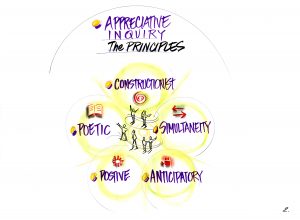
A diagram of the 5 principles of Appreciative Inquiry

The Link Between Appreciative Inquiry and Strengths

Appreciative Inquiry is a method for solving problems and implementing change by focusing on the positive. It emerged from the work of David Cooperrider and Suresh Srivastva in the late 1980s, and has since been used by businesses, teams and organisations around the world. The Ai (1) approach is perfectly aligned with the strengths-led approach,

The Link Between Appreciative Inquiry and Strengths Read More »