Workplace

The joys and perils of working from home

“Work from home”, they said. “So few distractions”, they said. “Lots of opportunities for focus and deep work”, they said. This happens multiple times a day. Molly likes, no, DEMANDS attention, and she’s very good at getting it! Lucky she’s so cute… https://youtube.com/embed/OrjdFLICTw4 Hat-tip to the fabulous AMANDA BILLING for the cosy and funky ‘Feminist […]

The joys and perils of working from home Read More »

shallow focus photography of yellow star lanterns

Is Your Team Made Up of Rockstars or Superstars?

I love the distinction that Kim Scott makes in her book ‘Radical Candor‘ [non-affiliate link] between rockstars and superstars. And I think it has huge implications for how we lead, manage, and shape teams in our workplaces. Rockstars vs Superstars – the definitions 🌟 Rockstar: a solid, stable performer on a gradual growth trajectory, or

Is Your Team Made Up of Rockstars or Superstars? Read More »

Podcast promotional tile, with title of podcast, a photo of Daria Williamson, and The Auckland Marketing Club logo

Podcast Appearance: How to Use Your Genius Strengths to Do More of What You Love

My friend Karl Craig-West hosted me on his podcast to talk about how to use your Genius strengths to do more of what you love. We talk about how you can figure out and use your Genius strengths, how to spot and collaborate with other people’s strengths, and how to use your unique strengths to

Podcast Appearance: How to Use Your Genius Strengths to Do More of What You Love Read More »

A photo of a white jigsaw puzzle on a black background, with a piece missing

How Can We Deal With “Wicked Problems”?

I’ve been thinking a lot recently about the concept of “wicked problems”. More and more, we’re facing complex and challenging issues as individuals, partners, parents, work teams and as a society. So what should we do when we’re faced with a problem that doesn’t have a simple solution? Unfortunately, it’s not as simple as finding

How Can We Deal With “Wicked Problems”? Read More »

A photo of a person with a box over their head labelled "brain" and a hand putting the word "idea" into the box

The Best and Wisest Piece of Advice I Ever Received

Back in my early 20s, I was given a piece of advice, and told that it works in every situation that humans face.  I initially couldn’t (or rather, wouldn’t!) accept the idea that it could apply in every context. And I tried really hard to imagine a situation in which it wouldn’t work… but even

The Best and Wisest Piece of Advice I Ever Received Read More »

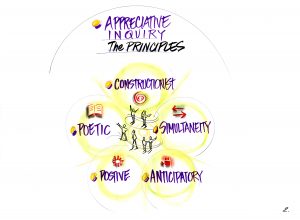
A diagram of the 5 principles of Appreciative Inquiry

The Link Between Appreciative Inquiry and Strengths

Appreciative Inquiry is a method for solving problems and implementing change by focusing on the positive. It emerged from the work of David Cooperrider and Suresh Srivastva in the late 1980s, and has since been used by businesses, teams and organisations around the world. The Ai (1) approach is perfectly aligned with the strengths-led approach,

The Link Between Appreciative Inquiry and Strengths Read More »

A crumpled piece of paper on a dark background. There is a large question mark on the paper.

Why we need to ditch certainty and embrace uncertainty

Certainty is highly prized by our brains. So much of what we do and say is aimed at creating certainty for ourselves, or projecting an aura of certainty for others to see. We often avoid uncertainty, because it can activate the threat-avoidance part of our brains. The problem is usually not the uncertainty itself, but

Why we need to ditch certainty and embrace uncertainty Read More »